Letter 29 - The Night of Terror Didn't Stop Them!

Hello Bregdan Woman!
It’s time to finish Alice Paul’s story! It comes back to the Silent Sentinels in front of the White House who refused to stop their protests despite the reality of entering World War I.
Welcome to part 3 of Alice Paul’s story. It’s one EVERY woman (no matter where you live) should know.
If you’re just jumping in, you’ll want to read Monday’s and Wednesday’s letters.
Over 2000 women, known as Sentinels of Liberty, joined with Alice Paul and the National Women’s Party at the White House protests. Every Sentinel of Liberty is one of my heroines.
Alice, as a Quaker, rejected violence of any kind. Though she had been involved with the Pankhurst Women in England, shattering her fair share of windows, when she returned to the US, she chose to embrace civil disobedience instead.
The other branch of the Suffragist movement, the one Alice had split from, threw its support behind the war effort, abandoning the fight for women’s right to vote. The same thing had happened fifty-six years before when the Civil War broke out in 1861. The decision suffragists made to step away from the fight resulted in black men receiving the vote – while women were passed over.
Alice knew history. She had no interest in repeating it.
Nine states had given women the right to vote by 1916.
You should know what states helped pave the way:
Wyoming – 1869
Utah – 1870
Idaho – 1896
Washington – 1910
California – 1911
Oregon – 1912
Montana – 1914
Arizona – 1913
Kansas – 1912
Alaska Territory – 1912
Illinois – 1913 – First state east of the Mississippi
Clearly, women fared better in the West!
Back to Alice Paul’s battle in the East…
President Wilson supported suffrage on a state level, but he opposed the federal amendment. The women decided to aim their protests directly at him.
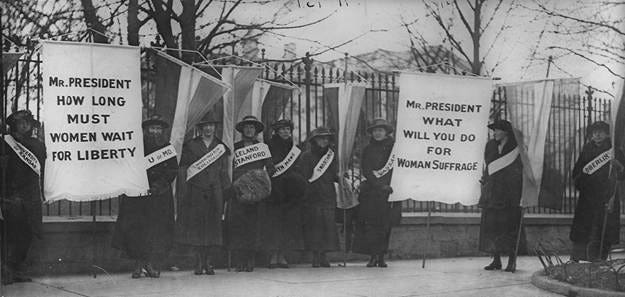
Their determination made them targets. They were attacked by angry mobs. They were arrested on the trumped-up charges of “obstructing traffic”. They were thrown into jail when they refused to pay fines for exercising their 1st Amendment rights.
The arrests continued. The prison terms kept getting longer. The treatment kept getting worse.
It did nothing but inspire these determined Bregdan Women.
More determined women filled in the ranks – continuing their demonstrations for freedom.
It’s important that you know about the Night of Terror on November 14th, 1917 – ten months into the protest.
As you read this, remember that all these women wanted was to have the right to vote – to be given a voice in their country.
In the long history of the suffrage movement, it was the most harrowing night – one that broke my heart to learn about and write about.
33 women had been arrested for their non-violent protest several days earlier. On November 14th, they were transferred to the Occoquan Workhouse. They demanded to be treated as political prisoners.
Instead, they were forced to strip naked, sprayed with water, and given rough, dirty uniforms to wear. They were not allowed to contact their families. The food they were given was full of worms. Ugghhh!
Alice Paul, who had actually been in prison since October 22, and several others started a hunger strike to protest their treatment. After several days, guards force-fed them by holding them down and shoving tubes up their noses or down their throats. They pumped raw eggs into their bodies.
While many letters of support were sent to the prison for the women, they were never delivered. Instead, Alice Paul was given this letter:
“Why not let this miserable creature starve. The country would be much better off without her and the balance of her gang of pickets. They are a rotten lot, and are crazy, and should be locked up for life. If they would starve it would save the expense of keeping them. Let them starve.”
Remember, all they wanted was the right to vote.
It got far worse.
Prison superintendent, William Whittaker, instructed his guards to teach the women a lesson.
That’s exactly what they did. They burst into the room where the women were being held for booking, dragged them down the hall and threw them into dark, filthy cells. The women were beaten and tortured. One suffered a heart attack when she watched her friend lose consciousness after being slammed onto an iron bed. The guards refused to call a doctor.
One of the Suffragists, Lucy Burns, was handcuffed in her cell with her hands over her head. She stood there all night.
Twenty-year-old Dorothy Day, who would later launch the Catholic Worker Movement, was lifted twice by guards and slammed down over a metal bench.
The administration recognized Alice Paul as their leader. They were determined to stop her, especially. She was taken from prison and moved to a sanitorium in an attempt to have her declared insane – a strategy used against many women during this time. Her attorney intervened and secured her release.
It was a dark, dark time for a country that espouses freedom.
I could write for days about what these women suffered that night. Every time I vote, or raise my voice to be heard, I think of them.
I hope that now you will, too.
The news of what was happening was released to the press by a sympathetic member of the Wilson administration and the husband of one of the prisoners. The newspaper accounts horrified the nation.
Two weeks later, a judge ordered the prisoners released and eventually vacated their convictions.
The women went home and continued their fight. If anything, their imprisonment and the Night of Terror, strengthened their resolve.
Over the course of the White House protests, a total of 168 Suffragists were arrested and sent to jail or prison.
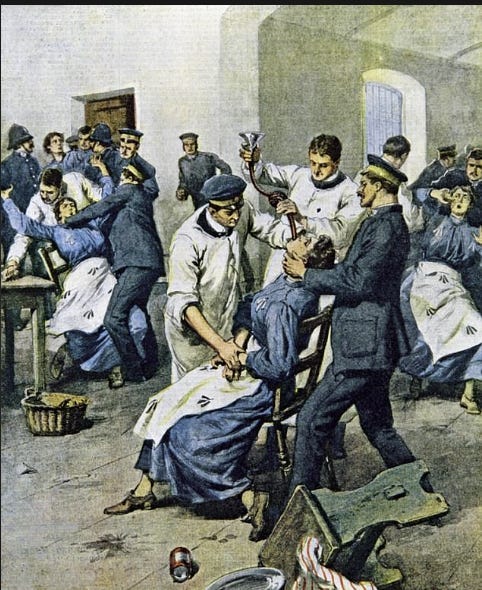
In front of the White House, the arrests continued. Many suffragists, including older frail women, were beaten, pushed to the ground, and thrown in cold, unsanitary, and rat-infested cells.
FINALLY, news of what was happening began to leak out of the prisons. Newspapers, even in the midst of war, reported on the hunger strikes and the conditions they were dealing with. Sympathy for the prisoners brought many to support the cause of women’s suffrage.
While President Woodrow Wilson espoused untiring advocacy of democracy around the world during World War I, he refused to take any meaningful effort to win it for the female half of his own country. Think about that…
It’s appalling that it took such brutality to turn the tide.
What was so terrifying about women’s right to have a voice in their own country?
Today… why do so few people – but especially women – know the truth about the price that was paid for our freedom to have a vote? Why did the price have to be so high?
As the truth became known, public demand grew for the women’s release – not just from the general public, but also from the press and from a growing number of politicians.
America was finally paying attention.
The women, including Alice Paul, were released, but the fight to vote was not over.
The Silent Sentinels continued to protest in front of the White House. I’m in awe of their determination and bravery!
By the end of 1917, bowing to public pressure, President Wilson was forced to reverse his position. He announced his support for a constitutional suffrage amendment. He met with members of Congress to gain support for it.
The wheels of politics usually move very slowly, but they were finally moving.
The world continued to struggle. Remember, nothing in history ever happens in a bubble. World War I did not end until November of 1918.
The Spanish Flu hit. The deadliest pandemic in world history, it infected some 500 million people across the globe. That is roughly one third of the entire human population at the time. 50 million people died – along with 675,000 in the US.
The women refused to slow down the momentum. The Silent Sentinels continued to protest.
Even in the midst of chaos, they knew their voices must continue to be heard.
And finally… the 100 year-old-battle came to an end. Well, kinda…
Congress passed the 19th Amendment in 1919.
It was ratified in 1920.
Every American woman was allowed to vote.
Right?
NO. Only the white women.
But that will be a story for another day.
Regardless of the long battle ahead for many American women, Alice Paul and the courageous women who fought with her, accomplished what women had fought for since 1820.
The Right to Vote!
Alice Paul, a powerful Bregdan Woman, is an example that one person can truly impact history and make a lasting difference.
I am forever grateful to her!
I’m not quite done, however. Many suffragists left public life and activism after the 19th Amendment was enacted.
Not Alice Paul.
She knew the true battle for legally protected gender equality had not yet been won.
With one victorious battle behind her, Alice went back to school. She earned three law degrees to better understand how legislation and laws were drafted and passed.
WOW!
Utilizing her knowledge and legal prowess, she wrote the Equal Rights Amendment (ERA) in 1923.
I don’t know about you, but I had no idea…
The problem is…
Women celebrate the ERA – without realizing it NEVER PASSED. It has never been ratified to the US Constitution.
Most women don’t realize how fragile their rights are in the USA.
There are women fighting TODAY to get the ERA ratified to the Constitution.
Let the fight continue!
Back to Alice Paul. She died in 1977 at the age of 92. She never stopped fighting.
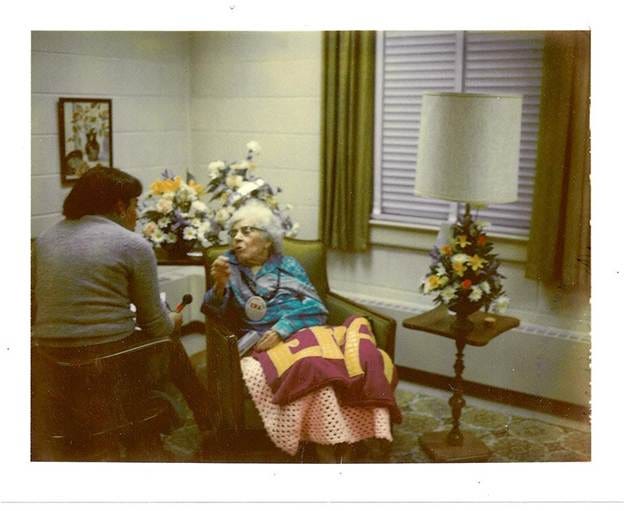
In 1985, the Alice Paul Institute was founded to honor her legacy and continue the fight for equality of ALL. The Alice Paul Institute educates and encourages women and girls to be leaders in their communities. They also lead efforts to FINALLY ratify the Equal Rights Amendment.
At the end of 3 days of reading or listening, you know I’ve got questions…
Will you vote in the next elections?
Will you educate other women about the price so many women paid to grant them that right?
Will you help continue the fight to guarantee equality for women?
It all boils down to…
What will you do today to be a Bregdan Woman?
What will you do today to impact history??
I’m on this journey with you!
Ginny